
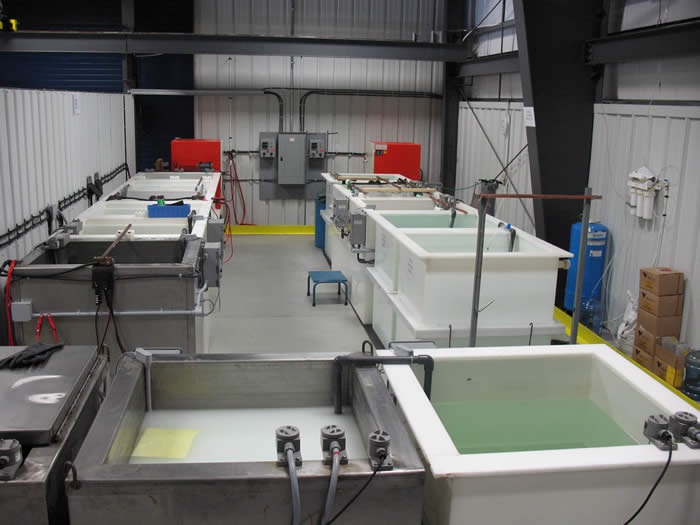
Tin-lead electroplating deposits a targeted alloy onto conductive substrates to improve low-temperature solder wetting while eliminating tin whisker formation in high-density electronics.
As an ISO 9001:2015 and ITAR-registered metal finishing facility, Catoctin Metal Finishing provides precision matte and bright tin-lead plating tailored to AMS-P-81728, ASTM B579, and MIL-P-81728 specifications using automated and semi-automated production lines. Review the technical process, key material benefits, and target industry applications below.
How Tin-Lead Plating Works
Tin-lead plating co-deposits a tin and lead alloy onto a substrate through an electrolytic process. The alloy composition is selected based on the desired properties and intended application of the finished part. Alloying tin with lead reduces the melting point of the coating, which is favorable when solderability is a primary requirement. The process produces finishes ranging from matte to bright, depending on bath chemistry and current density.
One important characteristic of pure tin plating is the potential for tin whisker formation: small conductive strands that grow from the surface and can cause electrical shorts in dense assemblies. The lead component in tin-lead plating prevents this phenomenon. All other performance characteristics of leaded matte and bright tin are similar to those of pure tin.
Uses of Tin-Lead Plating
Tin-lead coating is used wherever reliable solderability and post-fabrication ductility are both required. The alloy’s low melting point makes it practical for components that go through soldering operations, while its ductility protects surfaces during forming, stamping, and connector cycling.
Engineered tin-lead finishes serve three critical functional roles in mission-critical manufacturing:
- Solderable contact interfaces. Deposition of the alloy lowers the melting threshold, enabling clean solder wetting while shielding underlying assemblies from excess thermal exposure.
- Post-plating surface formability. High ductility allows the deposit to flex during post-plate stamping, crimping, and pin installation without cracking or delaminating.
- Tin whisker suppression. Co-depositing lead disrupts single-crystal filament growth, preventing electrical shorting across dense circuit architectures. For components where pure tin presents this risk, electroless nickel plating is another alternative finish worth evaluating.
Benefits of Tin-Lead Plating
Tin-lead coating consolidates several performance properties into a single electrodeposited layer. Electrodeposited tin-lead coatings combine several material advantages into a single continuous film, directly enhancing part life cycle performance:
- Lowered soldering temperatures. Reduces processing heat demands to protect sensitive components during assembly.
- Substrate corrosion barrier. Blocks atmospheric oxidation and moisture ingress on copper and copper alloys (Note: Passivation is recommended for stainless steel or aluminum substrates).
- Stable electrical conductivity. Preserves low contact resistance across mating surfaces and connector junctions.
- Formable ductile deposit. Absorbs mechanical strain during secondary forming or stamping operations without fracturing.
- Tailored surface finishes. Offers both matte (for reduced glares/solder holding) and bright finishes to fit specific aesthetic or assembly parameters, supported by optional copper underplating for optimal adhesion.
Applications of Tin-Lead Plating
Tin-lead plating is specified across industries where electrical performance and manufacturability must hold up under demanding production and field conditions.
Catoctin Metal Finishing delivers specification-compliant tin-lead plating across critical industrial sectors requiring high reliability under extreme conditions:
- Electronics. Applied to PCB leads, relay components, and power switch contacts to maintain solder wetting and protect delicate assemblies.
- Telecommunications. Protects RF connector interfaces and microwave housings against signal degradation and surface oxidation.
- Defense & military. Meets strict defense hardware standards by combining whisker mitigation with dependable solderability.
- Aerospace. Delivers thermally durable, ductile surface finishes for critical avionics components subject to temperature cycling.
Learn More About Catoctin Metal Finishing’s Tin-Lead Plating Services
Catoctin Metal Finishing is an ISO 9001:2015 and ITAR-registered metal finishing provider with over 40 years of manufacturing experience. We apply matte and bright tin lead plating to AMS-P-81728, ASTM B579, and MIL-P-81728 specifications using automated and semi-automated plating lines. Our team understands the specification and process requirements of the aerospace, telecommunications, electronics, and defense industries.
Ready to source tin-lead coating for your next program? Submit a request for quote or contact our team to discuss your part specifications and requirements.