

With over 40 years of experience, Catoctin Metal Finishing offers all of the plating, anodizing, and passivation services that the aerospace, commercial, defense, electronics, medical, and telecommunication industries rely on. We are ISO 9001:2015-certified, NADCAP-compliant, and ITAR-certified, and our automated equipment and plating processes allow us to provide cost-saving solutions for our valued customers.
Anodizing
Two types of sulfuric anodizing services are available for
aluminum parts:
- Type 2, Class 1 & 2 sulfuric acid anodizing.
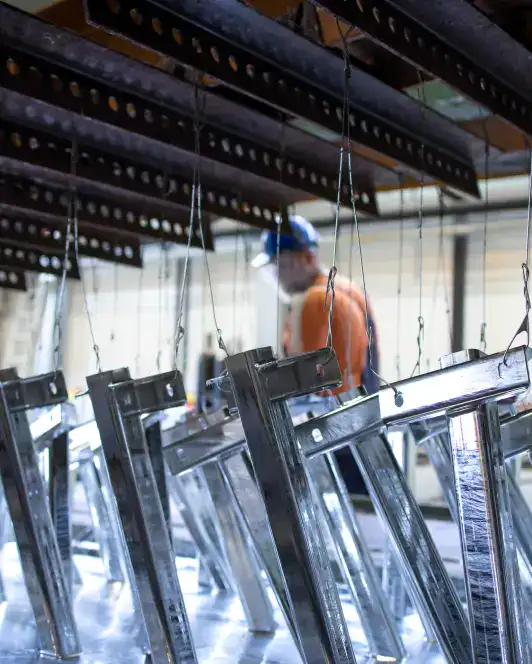
Also called conventional anodizing, in this process, parts are submerged in a sulfuric acid bath with an electrode to produce a porous aluminum oxide surface coating. This process protects the material from corrosion and wear, and creates a base for dyeing with color. Meets MIL-A-8625 Type 2 Class 1 & 2. - Type 3, Class 1 & 2 sulfuric acid anodizing.
Sulfuric acid anodizing, or hardcote anodizing, is used to protect aluminum parts in applications frequently exposed to harsh operating conditions. The process creates a dense, hard, and thick layer of aluminum oxide (up to 0.002 in. thick) that resists corrosion, abrasion, and wear. Meets MIL-A-8625 Type 3 Class 1 & 2.
Trivalent & Hexavalent Chromate Plating
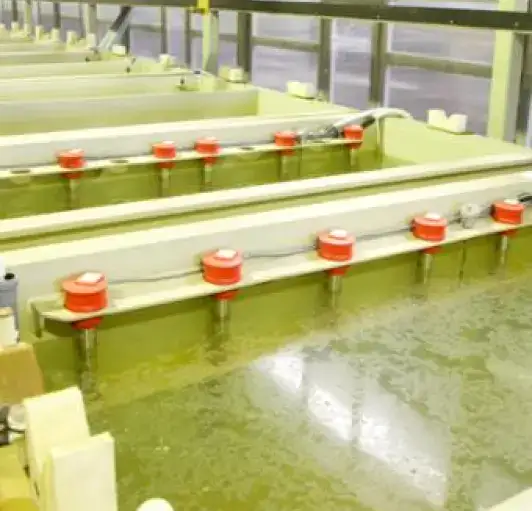
Trivalent chromate (Cr3+) offers excellent adhesion, even on intricate or recessed part features, and is RoHS/REACH-compliant. It is a less toxic option than hexavalent chromium, for an eco-friendly solution with corrosion and scratch resistance. It is available in several color options. Plating meets MIL DTL-5541 Type 2. Class 3. Hexavalent chromate (Cr+6, or hex-chrome) plating uses chromium
trioxide in an acid bath and deposits a hard, durable, decorative layer of chrome on parts and components. It is a traditional chrome plating method for creating functional and aesthetic parts. Plating meets MIL DTL-5541 Type 1, Class 1A.
Electroless Nickel Plating
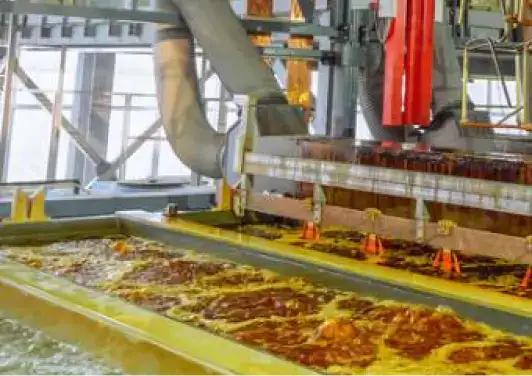
In electroless nickel-phosphorus plating, parts are submerged in a bath of nickel salt and a hypophosphite reducing agent. Metal ions
are reduced in an autocatalytic reaction, depositing an even layer of a nickel-phosphorus alloy onto the entire part surface. This method is suitable for non-conductive substrates and avoids uneven current density issues often seen in electroplating. Plating meets MIL-C-26074, B733-22, and AMS 2404.
Electrolytic Nickel Plating
In electrolytic nickel plating, parts are submerged in a chemical bath with an electric current. A layer of nickel is deposited on the part, and the thickness of the layer can be controlled to meet application requirements. It can result in uneven coatings on some shapes and part features, and metal parts require pre- and post-plating treatments to mitigate hydrogen embrittlement, which is caused through the introduction of hydrogen to the metal during plating.
Meets ASTM B689-97, QQ-N-290, AMS-2403, and AMS-2424.

Gold Plating
Gold electroplating adds a thin layer of gold on parts to improve corrosion resistance and conductivity. It is also more cost-effective than solid gold, and is a common choice for electrical contacts and medical devices, electronics components, connector pins, and decorative items and embellishments. Plating meets ASTM B488 and MIL-G-45204 standards.
Passivation
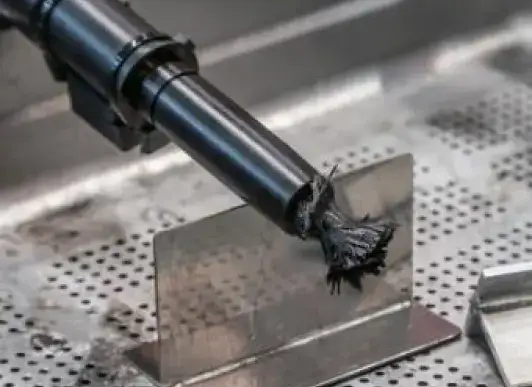
Many metals can be passivated, including aluminum, titanium, copper alloys, nickel alloys, carbon steel, silicon, and most commonly, stainless steel. In this process, the metal is cleaned and then treated with a nitric or citric acid solution, which causes the metal to form a thin, protective oxide layer. The oxide keeps the metal from reacting with the ambient environment and enhances corrosion and stain resistance. Meets QQ-P-35C, AMS 2700, and ASTM A967.
Silver Plating
Silver electroplating is used to improve conductivity in electronic components like switches, pins, or contacts, and to add an aesthetic finish on decorative parts or embellishments. There are three common methods for silver electroplating:
- Barrel plating, in which parts are tumbled in a large container while submerged.
- Rack plating, which is effective for controlling the thickness of the plating on areas of each part.
- Reel-to-reel plating, which is used for selective plating applications.
Coatings are classified by purity levels and surface appearance, such as matte, semibright, or bright. Meets ASTM B700.

Copper Plating
Copper plating is an electroplating process in which a thin layer of copper is deposited on a metal part or component using an electrolyte bath and electrical current. Copper plating enhances corrosion protection, thermal and electrical conductivity, and appearance. Plating meets MIl-C-14550, AMS 2418. ASTM B734 standards.
Tin-Lead Plating
Tin-lead plating, or solder plating, is used in electronics applications and other situations where good solderability is required. Tin and lead are mixed in varying ratios, or alloyed, and applied to components to improve their conductivity, corrosion and oxidation resistance, and wear resistance. Combining small amounts of lead with tin lowers the material s melting point and prevents the formation of tin whisker crystals. Meets AMS-P-81728, ASTM B579, and MIL-P-81728.