
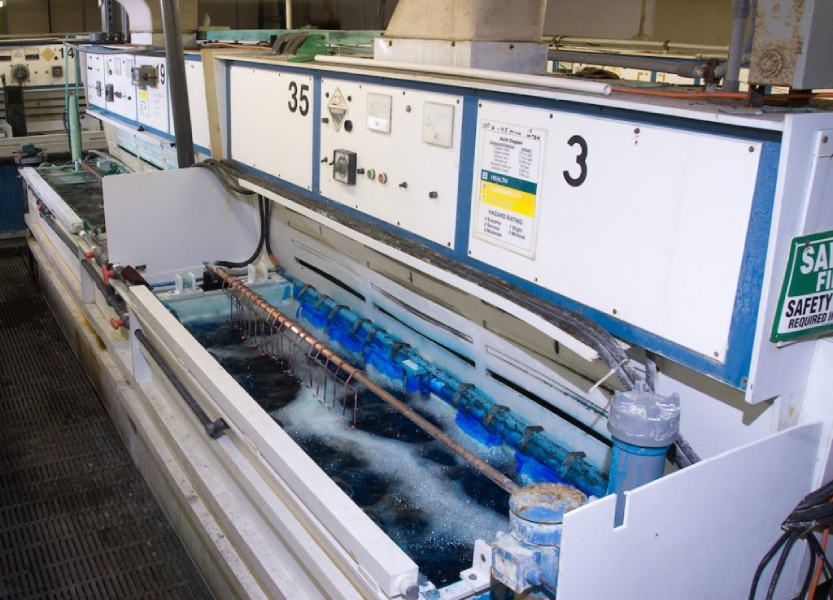
Gold plating remains one of the most reliable finishing methods for components requiring superior electrical conductivity, corrosion resistance, and solderability. As an ITAR-registered and ISO 9001-certified facility, Catoctin Metal Finishing provides gold-plated components that maintain performance in demanding environments where oxidation, wear, or contact degradation would compromise system reliability.
Catoctin Metal Finishing provides precision gold plating services per MIL-DTL-45204, the successor to MIL-G-45204, and ASTM B488 using both barrel and rack plating methods to accommodate production volumes and complex geometries. Our ITAR-registered, ISO 9001-certified facilities support defense, aerospace, and commercial applications with process controls designed for critical-use components.
Learn more about how to gold plate a component, the primary gold plating uses, and the various gold plating benefits.
How the Gold Electroplating Process Works
The process to gold plate a substrate involves electrochemical deposition to ensure precise coating thickness and uniformity. It begins with thorough surface preparation, where parts are cleaned and activated to remove contaminants that could affect adhesion.
Once prepared, parts enter an electrolytic bath where an electrical current moves gold ions from the solution to the part. The final deposit thickness depends on current density, bath temperature, and immersion time to meet specific application requirements.
Our primary industrial gold plating services include:
Hard Gold Plating
These formulations contain cobalt or nickel to increase wear resistance for electrical contacts experiencing repeated mating cycles.
Soft Gold Plating
These high-purity deposits maintain excellent solderability and wire bonding characteristics, making them the standard for semiconductor packaging.
Barrel & Rack Plating Methods
Our barrel plating method handles high volumes of small parts. For larger components, we utilize rack plating to accommodate specific contact point placement.
Uses of Gold Plating
Gold plating is essential across various high-reliability sectors where electrical performance is non-negotiable. Electronics manufacturers rely on gold for connectors and printed circuit boards because the material maintains stable contact resistance across thousands of mating cycles.
Medical device manufacturers specify gold on implantable components and diagnostic equipment. The biocompatibility of gold makes it suitable for devices that contact bodily fluids. Telecommunications infrastructure also depends on gold-plated connectors to maintain signal integrity in RF applications.
Defense contractors frequently seek specialized gold plating services. They apply these coatings to radar systems and guidance electronics. Field failures in these sectors carry significant operational consequences, making gold the preferred finish.
Benefits of Gold Plating
Gold resists tarnishing better than most other conductive metals. This property maintains electrical performance over time, particularly in applications exposed to humidity. The material also bonds readily with aluminum and gold wire. This makes it the standard choice for semiconductor die attach operations.
Understanding gold plating benefits helps engineers select the right finish for high-stress environments. Our processes provide several key advantages, including:
- Solderability. Gold surfaces accept solder without additional flux. This helps streamline assembly processes.
- Wear resistance. Hard gold formulations withstand mechanical stress from repeated connector insertions.
- Contact stability. Gold maintains low contact resistance to reduce signal degradation.
- Temperature performance. The coating remains stable across the temperature ranges required for automotive electronics.
Applications of Gold Plating
Connector manufacturers gold plate pins, sockets, and edge contacts for computer systems. Coating thickness varies by application. High-reliability connectors may require heavier deposits to accommodate wear. Conversely, cost-sensitive applications often use selective plating on primary contact areas only.
Semiconductor packaging operations find many gold plating uses for wire bonding. The pure gold surface creates reliable metallurgical bonds. This supports the electrical connections within integrated circuits. Test fixtures also rely on gold to maintain accurate electrical measurements during device characterization.
These functional gold plating benefits are often enhanced by an underlayer, such as our electroless nickel plating. We utilize this underplate when parts require additional hardness or a diffusion barrier beneath the gold deposit to prevent base metal migration.
Ready to Partner with Catoctin for your Industrial Gold Plating Services?
We work directly with project managers to match plating specifications to functional requirements. This includes selecting between hard and soft gold formulations and determining appropriate thickness ranges.
Our ITAR-registered facilities support aerospace and defense applications. In these fields, plating performance directly affects system reliability. Our process controls meet the requirements for highly demanding applications.
Ready to discuss your gold plating requirements? Contact our team to review your specifications and timeline or request a quote for your next gold plating project