
Catoctin Metal Finishing provides specialized industrial aluminum anodizing engineered to withstand aggressive operational environments and meet rigorous defense standards.
Machined metal components operating in high-stress environments require surface finishing treatments that increase surface hardness without risking adhesion failure or altering tight dimensional tolerances. Traditional coatings like paint or plating can flake or dimensionally distort critical parts. Our controlled anodizing processes transform the raw aluminum surface into an integrated, corrosion-resistant oxide layer engineered to withstand aggressive operational environments.
What Is Anodizing?
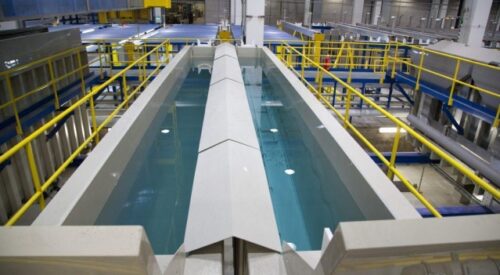
Anodizing is an electrochemical process that converts the exterior aluminum
surface into a durable, integrated aluminum oxide layer rather than applying an external surface coating.
The aluminum components are submerged into an acid electrolyte bath while passing a
direct current through the tank. This reaction releases oxygen ions at the positive anode (the part itself), which combine with aluminum atoms to build a precise oxide film. By controlling bath temperatures, current density, and chemical concentrations, our team achieves precise coating specifications across three primary process variations:
- Anodizing Type II (Sulfuric Acid Anodize). Produces a conventional, porous oxide layer that provides corrosion protection and acts as an optimal base for vibrant organic or inorganic dyes.
- Anodizing Type III (Hardcoat). Processed at lower fluid temperatures and higher voltages to build a denser, thicker oxide layer designed for severe abrasion and high-sliding friction applications.
- Sulfuric Acid Anodize Baseline. Functions as the primary chemical bath formulation behind both standard protective finishes and high-hardness applications.
Key Uses of Anodizing
Metal finishing treatments provide essential substrate insulation, surface hardness, and chemical bonding capabilities for complex mechanical assemblies. Key uses of anodizing include:
- Galvanic corrosion prevention. Insulates aluminum components when joined directly with dissimilar metals like stainless steel, preventing electrical flow and localized metal breakdown in outdoor or marine environments.
- Adhesive bonding primer. Creates a micro-porous oxide structure that functions as an anchor site for structural adhesives, sealants, and secondary topcoats.
- Electrical insulation. Converts the conductive raw aluminum surface into a naturally non-conductive oxide film for electronic housing enclosures.
Technical Benefits of Anodizing Services
Integrating anodized components into your manufacturing workflow delivers chemical stability and mechanical permanence unmatched by applied liquid or powder coatings. Top technical benefits of anodizing services include:
- Integrated layer integrity. Grows directly out of the base metal, eliminating the risk of peeling, flaking, or mechanical separation under high vibration.
- High wear & abrasion resistance. Type III hardcoat treatments yield surface hardness levels comparable to case-hardened steel, significantly reducing mechanical wear.
- UV & thermal stability. Resists degradation from ultraviolet exposure and aids heat dissipation across electronic enclosures.
Anodizing Applications
Our versatile anodizing services optimize physical performance parameters across an expansive array of demanding commercial markets. The medical sector depends on these treatments to fortify surgical trays, diagnostic housings, and orthopedic tools against harsh sanitation chemicals. Because the protective layer is completely non-toxic and biocompatible, it complies fully with sanitary manufacturing criteria.
In the aerospace and defense industries, parts must function flawlessly under severe pressure drops and violent structural vibrations. Engineers routinely specify anodizing type II and rugged anodizing type III to reinforce landing gear components, hydraulic valve manifolds, and radar housings. This protective layering ensures weapon systems and commercial flight hardware remain fully responsive in corrosive marine operational fields.
Partner with Catoctin Metal Finishing for Precision Anodizing
Our technical team reviews print specifications to ensure compliance with military specifications, strict engineering tolerances, and delivery schedules.
Request a quote to submit your project drawing specifications for review, or contact our engineering team to discuss your timeline and process requirements.