
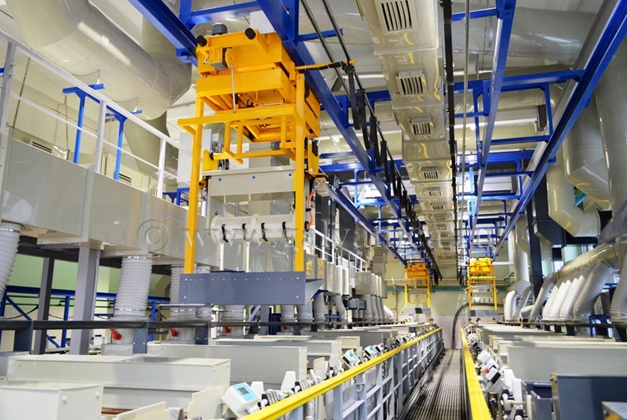
Managing dimensional wear and strict specification requirements on critical metal components requires precise surface engineering. Electrolytic nickel plating applies a high-purity nickel coating to a metal substrate through an electrically driven deposition process. This method delivers precise coating thickness, strong adhesion, and a consistently uniform finish for demanding B2B applications.
Catoctin Metal Finishing provides electrolytic nickel plating as one of our core surface finishing services, built around the exacting standards your project requires.
How Electrolytic Nickel Plating Works
The process starts with thorough surface preparation. Parts are cleaned and activated to remove oxides, oils, and contaminants that would compromise adhesion.
From there, the part is submerged in a nickel electrolyte bath, typically a sulfamate nickel solution. An electrical current passes through the bath, causing nickel ions to deposit onto the substrate surface. The current density, bath chemistry, and plating time are all controlled to achieve the target thickness and deposit properties.
The result is a dense, well-bonded nickel coating with tightly controlled internal stress levels. Depending on the specification, parts may also receive pre- and post-treatment to mitigate hydrogen embrittlement.
Our advanced plating facility conforms to rigorous industry benchmarks. Our electrolytic nickel process meets the following specifications:
- ASTM B689-97
- QQ-N-290
- AMS-2403
- AMS-2424
Uses of Electrolytic Nickel Plating
Selecting the right plating method depends on the structural role of the component and its operating environment. Electrolytic nickel is selected when the job calls for a high-purity deposit with tight dimensional control.
Engineers and project managers specify this process for several critical use cases:
- Dimensional restoration. Rebuilding mis-machined or worn parts back to drawing tolerance without scrapping the substrate.
- Underplating. Serving as an intermediate layer beneath gold, silver, or other precious metals to improve adhesion and reduce diffusion
- Engineering coatings. Providing a hard, wear-resistant surface on components exposed to friction or mechanical stress
- Electronics applications. Used in contacts and interconnections where consistent conductivity and solderability matter
Because electrolytic plating allows precise control over deposit purity and thickness, it’s often preferred when the end-use specification is strict or when part geometry requires a uniform build.
For applications where an even coating on complex geometry is the primary concern rather than a high-purity deposit, our electroless nickel service may be the better fit.
Benefits of Electrolytic Nickel Plating
Mechanical components benefit from the precise environmental controls maintained during electrodeposition. The advantages of electrolytic nickel stem from what the process is engineered to control.
This engineering approach yields distinct operational advantages:
- High deposit purity. Electrolytic nickel can achieve purity levels not possible with electroless processes, which always contain phosphorus or boron co-deposits. When the specification demands near-pure nickel, electrolytic nickel is the right method.
- Thickness control. Plating parameters are carefully controlled to achieve consistent coating thickness. This level of precision is critical for worn-part restoration and close-tolerance surfaces.
- Low internal stress. Sulfamate nickel baths are specifically chosen for their ability to produce deposits with low internal stress, reducing the risk of cracking or delamination on stressed parts.
- Coating type flexibility. The process adapts to multiple variants, including Type 1 (deposits free of hardeners or brighteners), Type 2 (controlled sulfur content for increased hardness), and Type 3 (composite deposits with dispersed particles like silicon carbide for elevated wear resistance).
Applications of Electrolytic Nickel Plating
Critical components across rigorous industrial environments depend on electrodeposited coatings to survive mechanical wear. Our customers span industries where performance, compliance, and reliability are non-negotiable.
Electrolytic nickel plating is routinely specified in the following sectors:
- Aerospace and defense. Structural and functional components subject to MIL and AMS specifications.
- Electronics and telecommunications. Connectors, contacts, and interconnections requiring stable conductivity.
- Medical devices. Components where biocompatibility, corrosion resistance, and precise dimensions are critical.
- Industrial and commercial equipment. Wear surfaces, molds, and tooling that benefit from a hard, dense nickel deposit.
Catoctin Metal Finishing brings over 40 years of metal finishing expertise, backed by ISO 9001:2015 certification and ITAR registration. We collaborate with project managers, engineers, and procurement teams across all of these sectors to ensure precise compliance and audit-ready documentation.
Optimize Your Components with Catoctin Metal Finishing’s Electrolytic Nickel Plating Services
If you’re evaluating electrolytic nickel plating services for an upcoming project, our engineering team is ready to review your technical requirements. Our facility supports programs requiring dimensional buildup on worn parts, qualified underplates for precious metal finishes, and high-purity engineering coatings manufactured to specification.
Request a quote to get started on your project layout, or contact us directly to discuss your specific technical applications.